Cybersecurity Monitoring Architecture Design Guide
A comprehensive framework for building enterprise-grade security monitoring capability — from global visibility and continuous detection to correlation analytics, automated response, and closed-loop operations across network, endpoints, identities, applications, and cloud platforms.
System Overview
This Network Security Monitoring System Design Guide defines an implementable framework to build a monitoring capability chain of "global visibility → continuous detection → correlation analytics → automated response → closed-loop operations." The system is positioned as an enterprise-grade monitoring architecture that unifies telemetry across network, endpoints, identities, applications, and cloud platforms, normalizes it through time synchronization, field standards, and asset/account mapping, and feeds it into a Security Operations Platform (SIEM). The system outputs prioritized alerts, confirmed incidents, evidence packages, response actions via SOAR/ITSM, and continuous improvement artifacts including rules tuning, detection gaps, and hardening tasks.
The guide addresses mid-to-large enterprises and regulated industries — including finance, energy, telecom, manufacturing, and government — operating mixed IT/OT and hybrid cloud environments. It covers asset scales from 5,000 to 50,000 endpoints, 500 to 5,000 servers, 50 to 500 network devices, and 100 to 2,000 cloud resources. Telemetry sources include syslog, Windows Event logs, EDR, NDR/flow, DNS, proxy, firewall, IAM/SSO logs, cloud audit logs, vulnerability scanner output, and configuration snapshots.
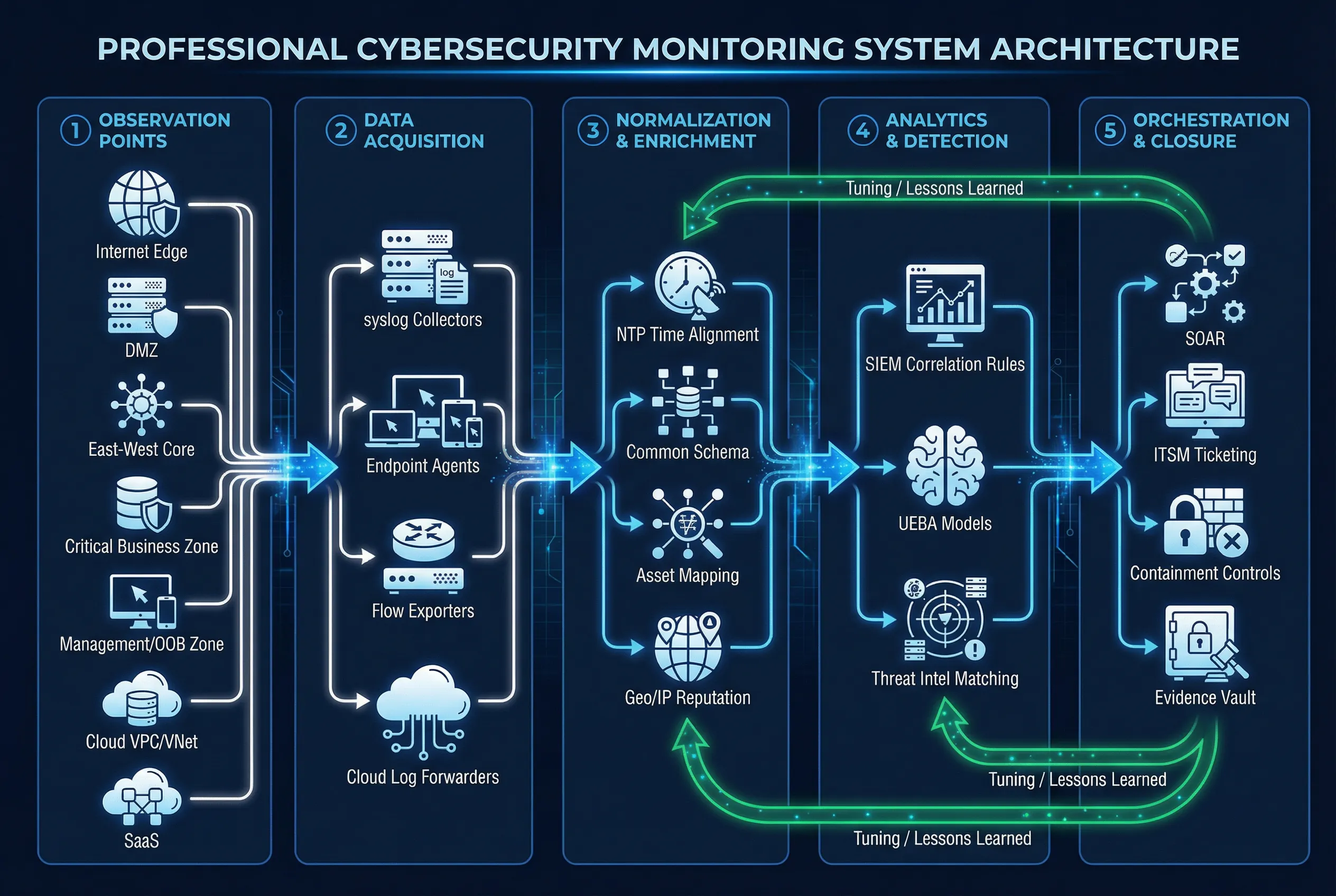
Scope and Boundaries
The in-scope coverage of this guide encompasses all major data source types including logs, flows, packet metadata, alerts, configuration snapshots, identity events, and cloud audit trails. Detection capabilities address intrusion, lateral movement, data exfiltration, account misuse, anomalous configuration, and policy drift. Operations coverage spans the complete incident lifecycle from triage through containment, eradication, recovery, post-incident review, and control improvements.
Out of scope: Replacing individual EDR/NDR products (this is an integration and operations architecture, not a single sensor); pure compliance log retention without detection; and offline/air-gapped environments with zero telemetry export, which require a separate offline SOC design.
Key Functions

The platform delivers eight core functional capabilities. Asset and data classification drives monitoring priority alignment with business criticality. Unified telemetry ingestion creates a single evidence plane across all source types. Standardization through time synchronization, schema normalization, and identity/asset mapping ensures correlation accuracy. Correlation analytics targets core attack scenarios to reduce noise while finding multi-step attacks. Layered alerting and prioritization controls SOC workload through severity scoring. Automated response via SOAR/ITSM accelerates MTTR with consistent, auditable actions. Tamper-resistant logging provides trustworthy evidence for investigations and audits. The metrics system enables continuous optimization through KPI tracking and tuning cycles.
Chapter Navigation
Inputs, Outputs & Key Dependencies
The monitoring system operates as a transformation engine that converts raw telemetry into actionable security intelligence. Understanding the precise inputs and outputs is essential for scoping the deployment and setting realistic expectations with stakeholders.
| Category | Items | Notes |
|---|---|---|
| Inputs | Telemetry, CMDB/asset inventory, identity directory, threat intelligence, baselines, vulnerability findings, network topology | Must be continuously synchronized; stale inputs degrade detection quality |
| Outputs | Correlated detections, incident cases, forensic timelines, automated containment actions, KPI dashboards, audit-ready evidence | Outputs feed back into control improvements and tuning cycles |
| Key Dependencies | Time sync (NTP/PTP), stable network paths for collectors, IAM integration, storage tiering, change control, on-call workflow | Failure in any dependency degrades the entire monitoring chain |
| Core Value | Converts fragmented security signals into actionable, prioritized, explainable incidents with measurable improvements | Measured via MTTD/MTTR, coverage, false positive rate, and closure rate |
Typical Deliverables
A complete deployment engagement produces a comprehensive set of artifacts that serve both operational and governance purposes. The following deliverables represent the expected output of a full implementation project.
- Final architecture diagrams and sensor placement plan
- Connector matrix with source-to-parser mapping
- Log schema standard and field normalization guide
- Detection catalog with ATT&CK mapping and severity model
- SOAR playbooks with approval gates and rollback procedures
- Acceptance test plan with simulated attack scenarios
- Operations and maintenance runbooks
- KPI baseline and continuous improvement framework